

Designed to relieve congestion across some of the city’s busiest corridors, the Dubai Loop represents a new approach to high-capacity, zero-emission urban transport, supporting Dubai’s long-term sustainability and smart mobility ambitions.
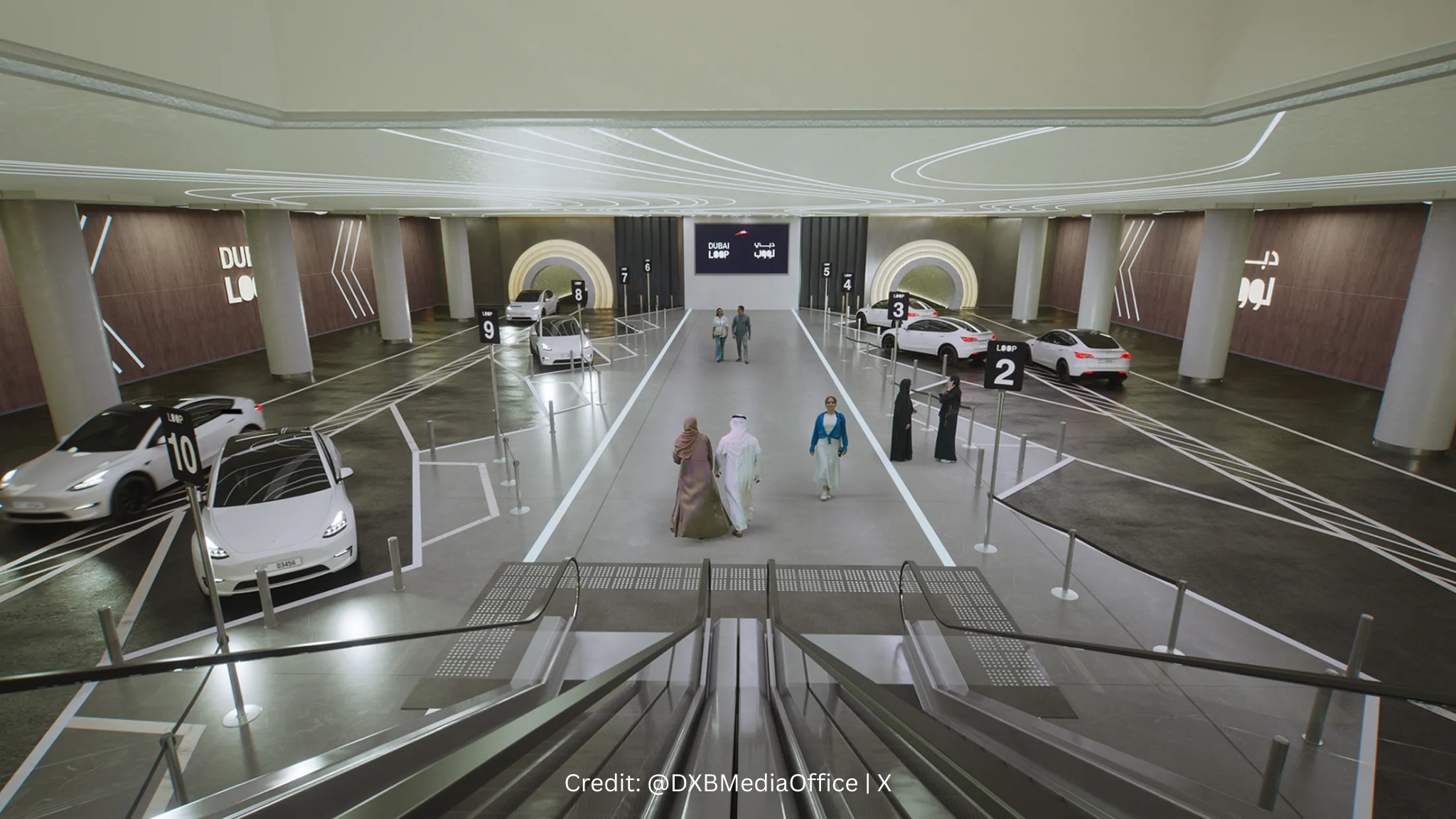
The project’s first phase will deliver a 6.4-kilometre underground pilot route with four stations, connecting key commercial, retail, and tourism destinations including the Dubai International Financial Centre (DIFC) and Dubai Mall. By moving traffic below ground and relying exclusively on electric vehicles, the system aims to significantly reduce surface congestion while improving travel efficiency in the city core.
According to Dubai’s Roads and Transport Authority, construction has begun immediately, with the pilot phase scheduled for completion within two years.
This initial stage will serve as a foundation for a much larger network. Once fully developed, the Dubai Loop is planned to extend 22.2 kilometresins with 19 stations, linking the Dubai World Trade Centre, the financial district, and Business Bay into a seamless underground mobility corridor.
The system is expected to handle up to 30,000 passengers per day, with the pilot phase alone serving approximately 13,000 daily riders. Operating similarly to The Boring Company’s Loop system in Las Vegas, the tunnels—each measuring 3.6 metres in diameter—will enable point-to-point electric transport without intermediate stops.
As cities worldwide seek scalable solutions to congestion, emissions, and urban space constraints, projects like the Dubai Loop highlight how integrated, electric, and space-efficient transport systems can play a role in shaping the future of sustainable urban mobility.
Why It Matters
As cities grow denser, the challenge is no longer just moving vehicles—but moving people efficiently, sustainably, and safely. The Dubai Loop demonstrates how underground, electric mobility systems can reclaim surface space, reduce congestion, and cut transport-related emissions while maintaining high-capacity urban connectivity.
By integrating advanced tunneling, electric transport, and smart city planning, projects like the Dubai Loop show how future mobility solutions can work within existing cities—rather than expanding them outward—supporting more livable, people-centered urban environments.
EMG Perspective
The Dubai Loop reflects key EcoMobility Global themes, showcasing how urban systems, smart infrastructure, and zero-emission transport can come together to create scalable, people-first mobility solutions for rapidly growing cities.